
- Foundation
- About 12 min
- 5 practice questions
Animals of the forest and their features
Sort forest animals into those on land and birds in the sky, match animals to a special feature, and read footprints like a nature detective.
If something looks wrong, please tell us.
By the end of this lesson you can
- Sort animals into land animals and birds.
- Name a special feature of some animals.
- Guess an animal from its footprint.
A forest has animals of many kinds. Some walk on land. Some fly in the sky. Each animal has special body parts that help it live.
Land animals and birds
Animals in a forest
-
On land
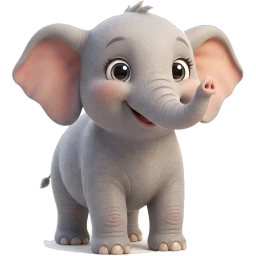 Elephant
- Deer
 Tiger
- Gaur
 Rabbit
- Squirrel
-
In the sky (birds)
 Eagle
- Hornbill
- Peacock (flies short distances)
- Sparrow
 Owl
Special features
| Animal | Special feature | How it helps |
|---|---|---|
| Elephant | Long trunk | Picks up food and sucks up water |
| Sparrow | Short, strong beak | Cracks seeds |
| Gaur | Big, strong body and short horns | Looks like a buffalo but is much stronger |
| Indian giant squirrel | Big body with red-brown fur | Lives high in trees in some forests |
| Owl | Large eyes | Sees well at night |
Some animals have funny names. The spectacled monkey has white rings around its eyes, like spectacles! It is the state animal of Tripura.
Reading footprints
Near a pond, animals come to drink water. They leave footprints in the soft mud. Footprints tell us who visited. A deer leaves two pointed marks from its split hoof. A big cat leaves round pads with no claw marks. A bird leaves thin toe marks, usually three pointing forward.
Let us try: Who drank here?
Arya sees two pointed marks, side by side, in the mud. Step 1: Two pointed toes mean a split hoof. Step 2: Deer have split hooves. Step 3: So a deer probably came to drink.
Let us try: Compare two squirrels
Sarthak compares a garden squirrel with the Indian giant squirrel. Step 1: The garden squirrel is small with stripes on its back. Step 2: The giant squirrel is much bigger with red-brown fur and no stripes. Step 3: Both have bushy tails and climb trees.
Every animal has special body parts that suit the way it lives.
Try at home with a grown-up: make your own footprint
- Fill a tray with damp sand or soft soil.
- Gently press your hand or foot into it, then lift it.
- Press a toy animal's feet too, if you have one.
- Compare the shapes and draw them in your notebook.
For the grown-up: Look at pigeons, dogs or cows near your home and talk about their feet. Ask your child to guess who left marks on a muddy path.
Key takeaways
- Forest animals include land animals and birds.
- Body parts like the elephant's trunk or the sparrow's beak suit how each animal lives.
- Footprints in mud tell us which animals passed by.
Check your understanding
-
1. What does an elephant use its trunk for?
- Picking up food and sucking up water
- Flying
- Swimming fast
- Cracking nuts
Show answer
Answer: A. An elephant's long trunk helps it hold food and draw up water to drink.
-
2. Which of these is a bird?
- Gaur
- Deer
- Rabbit
- Hornbill
Show answer
Answer: D. A hornbill has feathers, wings and a beak. Gaur, deer and rabbit are land animals.
-
3. Why can an owl hunt at night?
- It glows in the dark
- It has large eyes and sees well in the dark
- It never sleeps
- It has a long trunk
Show answer
Answer: B. Owls have big eyes that help them see in very low light.
-
4. A sparrow's short, strong beak helps it to:
- Crack seeds
- Catch fish
- Drink nectar
- Tear meat
Show answer
Answer: A. Sparrows eat grains and seeds. A short, strong beak cracks them open.
-
5. Footprints near a pond help us know:
- How deep the pond is
- What the weather is
- Which animals came to drink water
- How old the trees are
Show answer
Answer: C. Animals leave marks in soft mud. Their shape tells us which animal visited.
Sign in to keep track of the lessons you finish.